Introducing The South Australian Community Peace Project
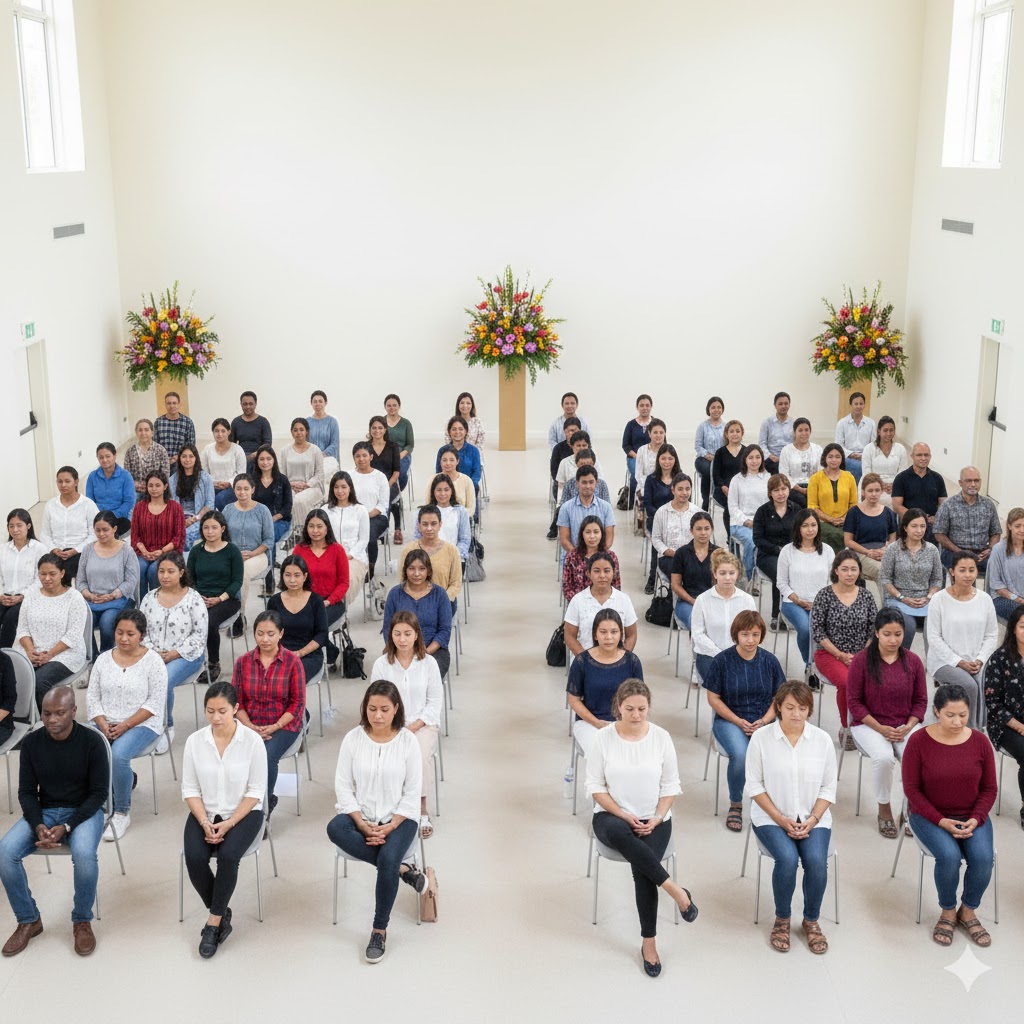
Studies show that a group of people practising the Technology of Transcendental Meditation together can improve the quality of life in the whole society, just as one drop of dye can change the colour of a glass of water.

There is ample scientific evidence to support this proposal.
It employs the Technology of the Unified Field to enhance the operating system of the state; when the group is trained to experience and function from the source of thought, the whole society will become more orderly and peaceful. By establishing this project, the Government can expect the following outcomes to manifest within days of it reaching full capacity:
How it Works
When we drop a pebble into a still pond, it creates perfectly concentric, synchronized circles. A wave of energy moves through the field of the water.
Similarly, a relatively small group (the square root of 1% of the population) can influence the entire society. By meditating in one place, the participants, create a wave of order strong enough to affect the entire state.
What We can Expect
1. A Dramatic Drop in Crime
Expected Result: 20% to 25% Reduction in Violent Crime.
The Basis:
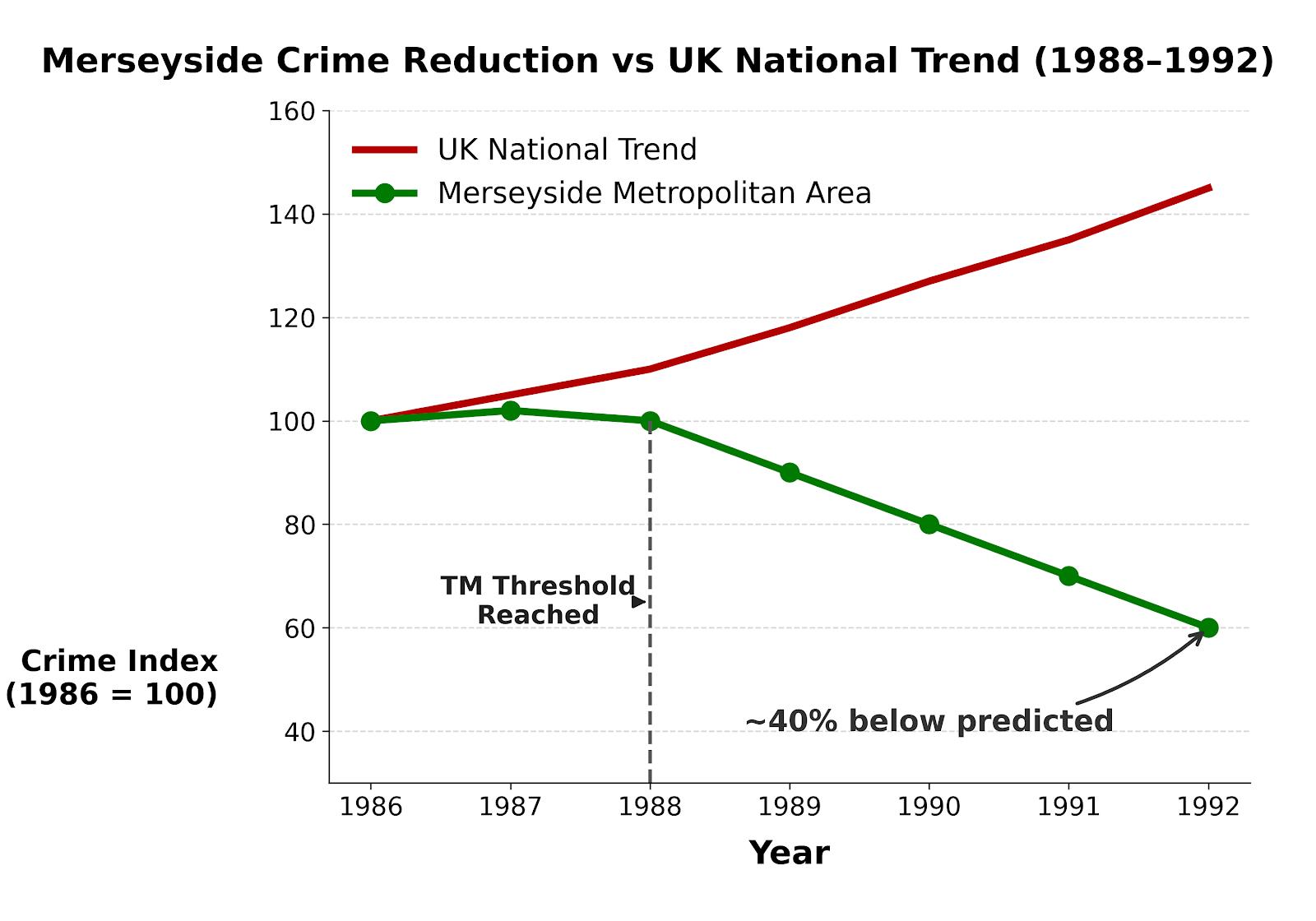
The Merseyside Absolute Drop: In 1988, when a meditation (TM) group in Skelmersdale, UK reached the required size, the Merseyside region experienced a dramatic drop in crime.
While crime rates were rising across the rest of the UK, Merseyside’s crime rate fell so sharply it became the lowest in the country.
By 1992, it had 40% less crime than expected based on national trends.
The Body of Evidence: These results are part of a consistent pattern documented in over 50 peer-reviewed studies.
Effect on SA: Based on South Australia Police’s current data of roughly 200,000 “offences against person/property” annually, a 20% reduction would mean 40,000 fewer crimes per year in South Australia
2. Expected Result: 10% to 15% Reduction in Public Health Expenditure
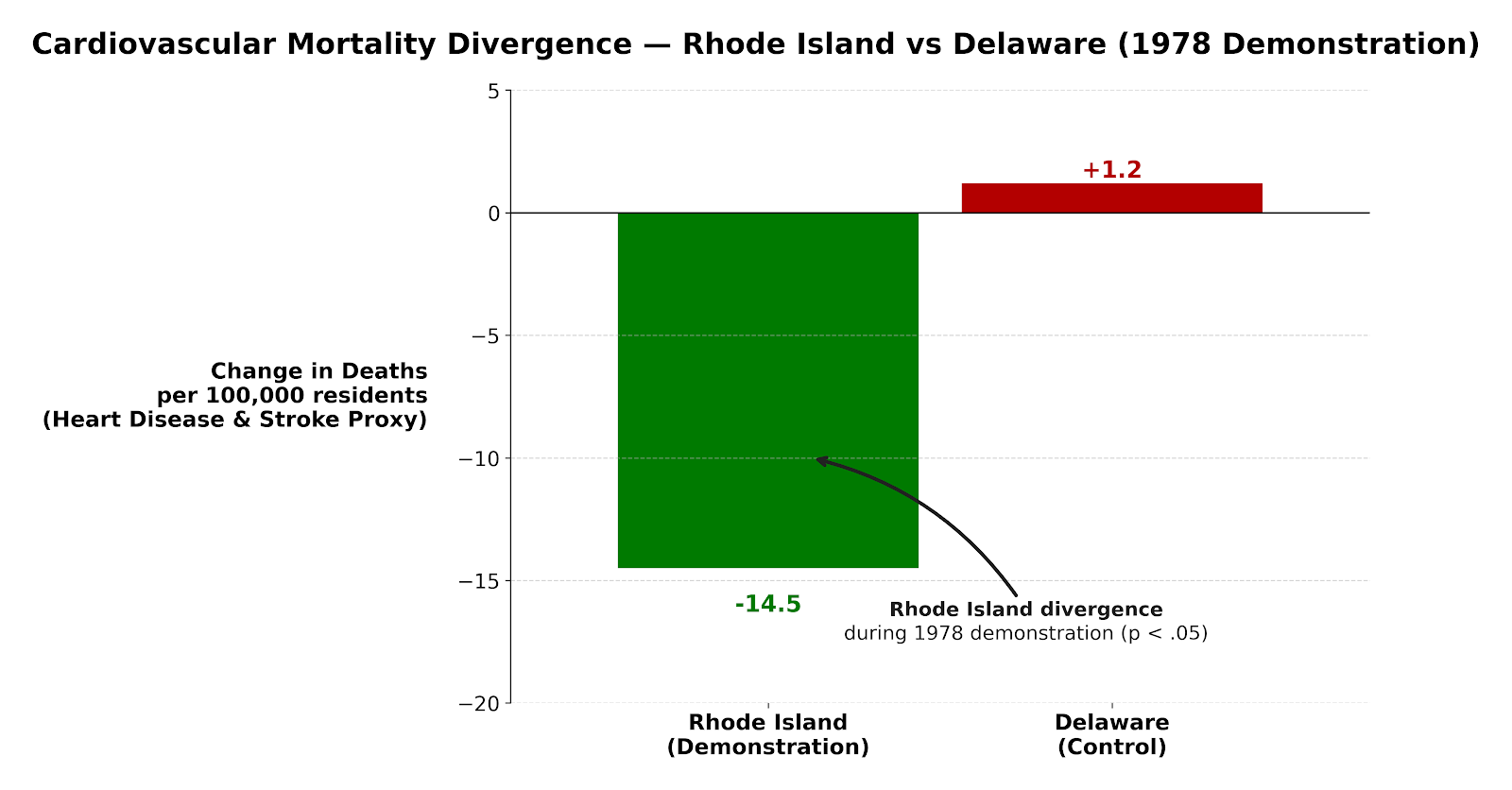
The Basis: The 1978 Rhode Island vs. Delaware Comparative Study, page 28 of 37
Statistical Confidence: p < .01 (99% Certainty)
In 1978, a controlled sociological experiment was conducted to test the Field Effect of collective consciousness.
A group of practitioners exceeding the square root of 1% (√1%) threshold of the population was established in Rhode Island.
The study compared Rhode Island’s performance against Delaware—a matched control state with similar demographic and economic profiles—to determine if a group of practitioners could improve the “Quality of Life” (QOL) for an entire non-practising population.
- Reduction in Mortality: A statistically significant drop in all-cause mortality was observed (p < .01). This suggests a “biological smoothing” effect where reduced collective stress led to fewer stress-triggered health crises (such as cardiac arrests) in the general public.
- Behavioural Shifts: Significant declines were recorded in social friction indicators, including a reduction in crime and traffic fatalities.
- State-Wide Divergence: While the control state (Delaware) followed national trends of increasing or stagnant stress indicators, Rhode Island’s QOL index showed a sharp upward divergence.
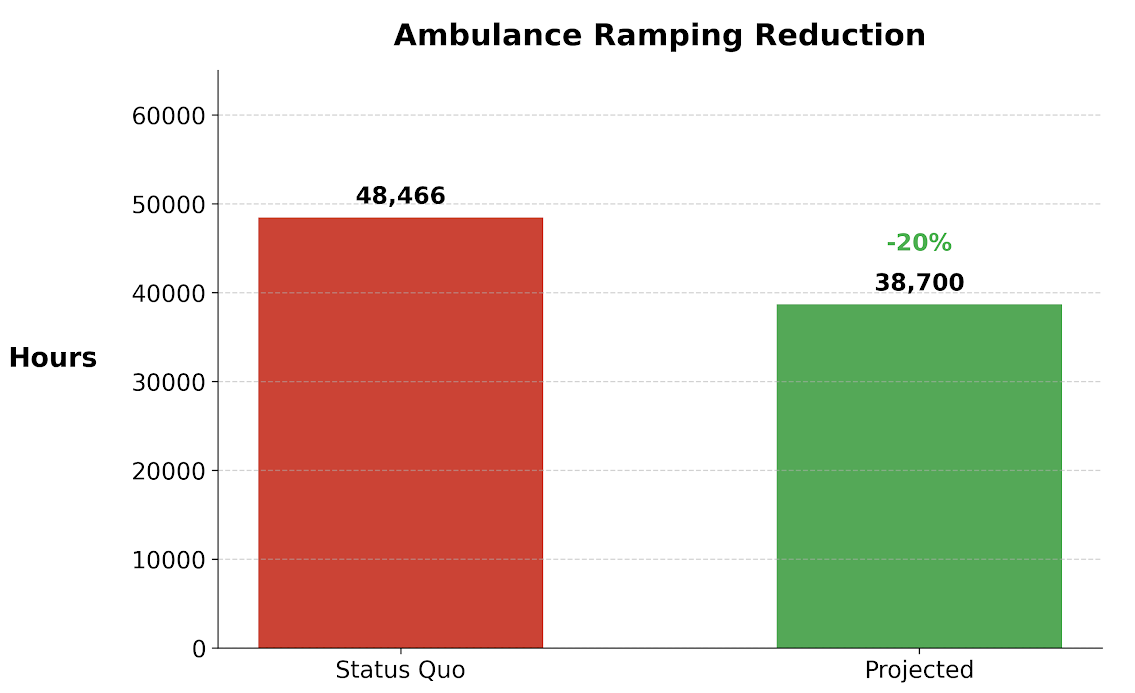
Effect on SA: Relief for SA Health: There will be a measurable decrease in emergency room admissions and ambulance ramping as demand for these services reduces naturally.
3. The Economic Logic: Prevention is Better than Cure, and Cheaper too.
- The Current Situation: Like all modern jurisdictions, South Australia allocates significant resources toward managing the societal impact of stress, including the high costs of healthcare, policing, and correctional services. Incarceration remains a particularly heavy fiscal burden; in Australia, the real cost of housing a single prisoner has now reached approximately $147,000 per year ($405 per day)
- The Alternative: Investing $18 million in a proactive group to promote a calmer and more orderly community environment, will generate savings of at least $98 million, a return on investment of 420%.
- The Result: A higher-efficiency state where safety and health are improved at the source, rather than repaired after a negative event has occurred. The savings in the first year that the group reaches optimum size alone will exceed all setup and operational costs.
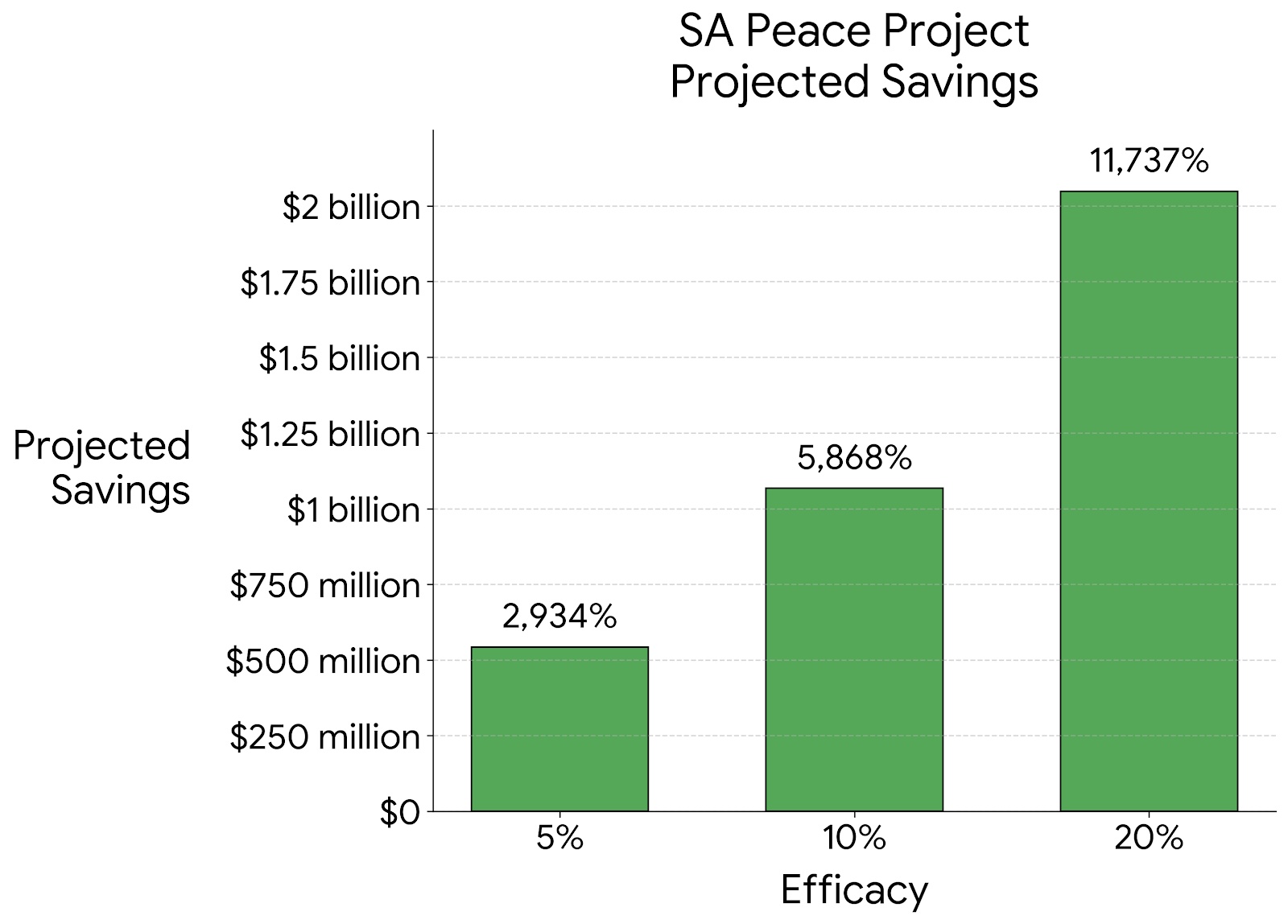
By applying the efficacy rates (5%, 10%, and 20%)—bench-marked against the results seen in the Rhode Island study—we can calculate the Avoided Cost and hence the savings for the SA State Budget.
The Field Effect
It seems difficult to accept because we are used to linear solutions — like hiring more police to catch criminals, or building more hospitals to handle more sick people. This technology is fundamentally different because it is non-linear.
It functions through a Field Effect at the level of the Unified Field—the most fundamental, self-organising level of nature’s intelligence.
Just as a single broadcast tower can provide a signal to an entire city, or a vaccine creates ‘herd immunity’ without treating every individual symptom, this technology generates a specific threshold of coherence from a single location to improve life-supporting behaviour in the whole population.
By operating at the source of nature’s laws rather than on the surface of social friction, a group of just 230 practitioners can generate a ‘Peace Dividend’ of $500M+ at a conservative efficacy rate of 5%. We will no longer be just managing symptoms; we will be stabilising the entire system from its most fundamental level – pure intelligence.
Executive Summary: Incorporating a Proactive Policy
South Australia’s governance will benefit from a non-linear solution to lower the baseline of social stress.
We propose the establishment of a permanent Coherence Group of 230 professional practitioners. This specific number is derived from the √1% threshold of the South Australian population (135), plus a robust 90-person safety margin to ensure the effect is sustained 24/7.
This initiative will enable us to more effectively manage the symptoms of social friction by addressing the root cause: Collective Stress.
The Peace Dividend: A Fiscal Imperative
By establishing a “Coherence Hub,” the State can expect a measurable reduction in the social friction that currently drives $9.5+ billion in annual expenditure across Health, Policing, and Corrections.
- Health: A mere 5% reduction in demand would recover $410 million annually for the Treasury.
- Justice: Preventing just 5% of anticipated crimes would save the State $20 million in direct court and policing costs every year.
Implementation Strategy
To realise the Peace Dividend, we propose a three-stage rollout that incorporates the 18-month professional development cycle required for practitioners to reach “deployment-ready” status.
Phase 1: The Feasibility Audit (Months 1–3)
Action: Commission an inter-departmental audit between Treasury, SA Health and SAPOL to discern “Incoherence Costs”—the specific budgetary expenses caused by crime and accidents.
- Objective: Establish the baseline metrics against which the Benefit-Cost Ratio will be measured.
Phase 2: Professional Workforce Training (Months 4–22)
Action: Recruit and initiate the 18-month training protocol for 230 South Australian practitioners.
- The Investment: This “Social Infrastructure” requires a training period to ensure practitioners are established in the advanced TM-Sidhi protocols.
- Objective: Build the professional capacity of the group to ensure the √1% threshold is met with a permanent safety margin of 95 practitioners.
Phase 3: Activation & Field Effect (Month 22 Onward)
Action: Transition the group to full-scale, twice-daily collective practice.
- The Result: System-wide markers of stress—crime, hospital admissions, ambulance ramping, and road accidents—will begin a statistically significant drop after the coherence field is established.
- Funding: Transition the project to a permanent budget line-item, fully offset by the multi-million dollar savings generated in the Health, Attorney-General’s and Correctional Services portfolios.
Recommendation
South Australia is already a world leader in the fields of Renewable Energy Integration, and Waste Management and Sustainability.
Once this project has delivered measurable relief to our state’s hospitals, police force and correctional services, we will have created a ‘South Australian Blueprint.’
We can then show it to the Federal Government, with the purpose of upscaling it to enable the whole of Australia to benefit from this technology of management of social stress.
When this project is implemented, our State will be positioned as the first in the world to manage collective stress as a vital public service.
We would not be just adding a new program; we would be displaying a new South Australian model for 21st-century governance.
We invite the Government of SA to authorise a preliminary briefing.
The mathematics of the √1% threshold are clear – this project will deliver benefits to the State on a very significant scale.
The amount invested will yield a substantial dividend.